

posted 18th April 2026
Neurological Physiotherapy Exercises: Evidence-Based Foundations
Part 1 of our neurological physiotherapy exercise series
Neurological physiotherapy exercises play a key role in improving movement, balance and independence for people living with neurological conditions. In this guide, we explain the core principles behind effective rehabilitation and how exercises are used in real clinical practice.
This article focuses on the types of exercises and approaches that support recovery in conditions such as stroke, multiple sclerosis and Parkinson’s disease.
Key Takeaways
- Neurological physiotherapy exercises target movement, balance and strength deficits
- Task-specific, progressive training supports functional recovery and independence
- Balance, gait and strength exercises form the foundation of rehabilitation
- Proper assessment and safety considerations are essential
- Combining multiple exercise approaches leads to better outcomes
Neurological conditions affect millions of people worldwide, with stroke alone impacting over 15 million individuals annually. Recent years have witnessed remarkable advances in understanding how targeted neuro exercises physio interventions can harness the brain’s neuroplasticity to restore function and improve quality of life. Evidence demonstrates that 60-70% of patients show measurable improvement in independence and mobility within the first six months of structured neurological physiotherapy, making these interventions a cornerstone of rehabilitation.
The science behind neurological recovery has evolved significantly, revealing that exercise-driven rehabilitation can increase brain-derived neurotrophic factor (BDNF) and nerve growth factor (NGF) expression—key molecules crucial for neuroplastic change and recovery. This understanding has transformed how neurological physiotherapists approach treatment, shifting from passive interventions to active, evidence-based exercise programmes that specifically target each patient’s unique needs and recovery potential.
Understanding Neurological Physiotherapy Exercises
Neurological physiotherapy represents a specialized branch of physiotherapy focused on neurological conditions, addressing disorders of the nervous system, including the brain, spinal cord, and peripheral nerves. Unlike general fitness activities, these exercises are personalized interventions rooted in comprehensive evaluation methods that assess movement, function, and individual goals.
The foundation of neurological physiotherapy lies in neuroplasticity principles—the nervous system’s remarkable ability to reorganize and adapt after injury or illness. When neurological physiotherapists design exercise programmes, they leverage this plasticity through targeted movement practice and repetition, helping patients relearn motor skills through structured rehabilitation.
Neurological physiotherapy exercises are designed to focus on functional movement patterns that support independence in daily activities. Repetitive practice of real-world tasks plays a key role in promoting functional recovery, helping individuals regain confidence in movements such as walking, reaching and transferring. These rehabilitation approaches are used across a range of conditions including stroke, spinal cord injury, multiple sclerosis and Parkinson’s disease, with programmes tailored to each individual’s needs and goals.
Conditions That Benefit from Neurological Physiotherapy
Common neurological conditions that benefit from specialized physiotherapy exercises include:
- Stroke: where patients may experience hemiplegia affecting one side of the body
- Multiple sclerosis: causing fatigue, muscle weakness, and coordination difficulties
- Parkinson’s disease: characterized by movement slowness and balance challenges
- Spinal cord injury: resulting in various degrees of paralysis
- Traumatic brain injury: affecting cognitive-motor integration and overall function
The key difference between neurological exercises and standard fitness routines lies in their focus on functional movement patterns rather than isolated muscle strength. For example, a stroke survivor might practice reaching movements that simulate dressing tasks, while someone with Parkinson’s might work on rhythmic stepping exercises to overcome gait freezing episodes.
Research shows that chronic physical exercise, as opposed to isolated training sessions, is pivotal in long-term neurological rehabilitation. A single week of rigorous, daily training has been shown to elevate BDNF levels and correlate with improved motor skills in both animal and human subjects, demonstrating the importance of consistent, structured exercise programmes.
Struggling to Know Which Neurological Exercises Are Right for You?
Understanding the right approach to neurological physiotherapy exercises is one thing — applying them safely and effectively is where real progress happens. Every individual’s recovery is different, and the wrong approach can slow things down.
Our physiotherapists provide structured, personalised rehabilitation programmes designed to improve movement, balance and independence — all delivered in the comfort of your own home.
Core Components of Neurological Exercise Programs
Balance Training Protocols
Balance training forms a fundamental component of neurological rehabilitation, addressing postural control deficits that commonly affect patients with neurological conditions. Static balance exercises begin with basic standing positions, progressing from supported stance with feet together to single-leg stance variations. Patients might start by standing near a wall for support, gradually reducing assistance as control improves.
Dynamic balance challenges introduce controlled movement while maintaining postural stability. These exercises include weight shifting from one leg to another, reaching activities in different directions while standing, and stepping patterns that challenge the body’s center of gravity. A patient with multiple sclerosis might practice reaching for objects placed at various heights and distances, simulating real-world activities like retrieving items from shelves.
Sensory integration exercises specifically target the visual, vestibular, and proprioceptive systems that contribute to balance control. Examples include standing with eyes closed to challenge reliance on vision, head movements while maintaining balance to stimulate vestibular function, and standing on foam surfaces to enhance proprioceptive awareness. These activities help patients develop confidence in various environmental conditions.
Progressive difficulty levels ensure appropriate challenge without compromising safety. Patients advance from supported activities using parallel bars or chairs to unsupported standing and walking tasks. Equipment-based balance training incorporates wobble boards, foam pads, and stability balls to create controlled instability that promotes adaptive responses.
The evidence supporting balance training is robust, with studies showing significant improvements in fall risk reduction and functional mobility. For patients with stroke, balance training can reduce fall risk by up to 30% and significantly improve confidence in daily activities.
Balance training is also a key part of reducing fall risk and restoring functional independence in neurological rehabilitation. Many programmes incorporate exercises that challenge the sensory systems, helping individuals improve stability and adapt to different environments and real-world situations.
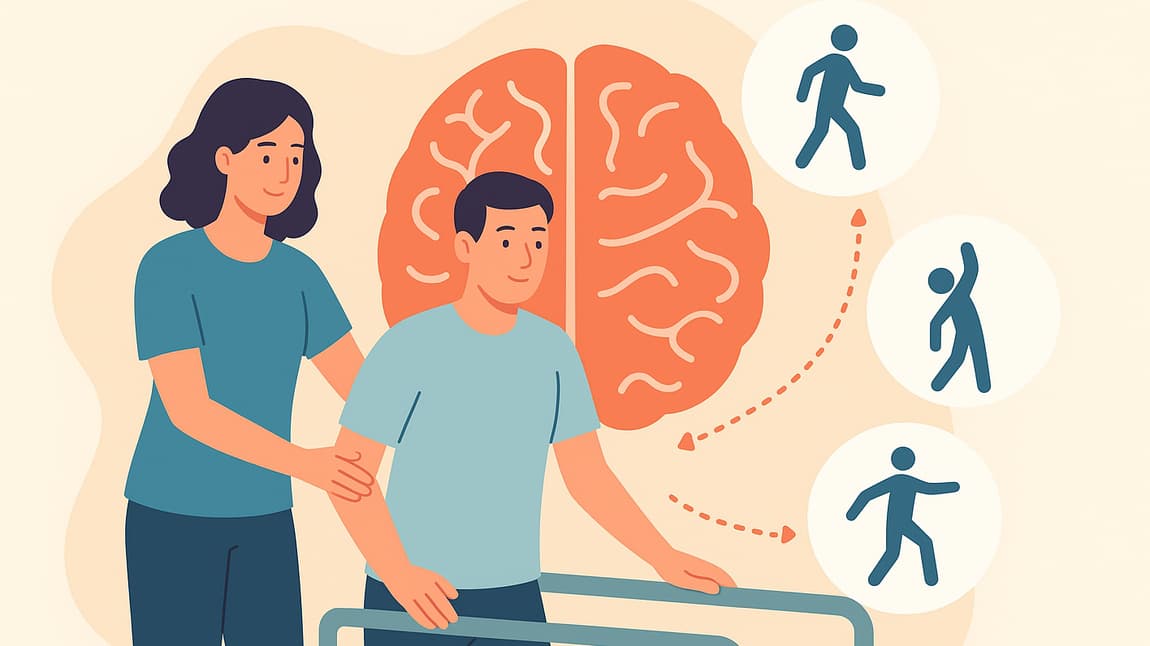
Balance and gait training using parallel bars allows safe, progressive rehabilitation while improving confidence and mobility.
Strength Training Adaptations
Strength training in neurological physiotherapy differs markedly from conventional weight training, focusing on functional patterns and movement quality rather than maximum force production. Progressive resistance exercises are carefully tailored to address specific neurological impairments while promoting motor unit activation and muscle control.
Functional strength training targets activities of daily living, ensuring that strength gains translate to improved independence. A patient recovering from stroke might practice sit-to-stand exercises from chairs of varying heights, simulating real-world scenarios and building leg strength essential for mobility. These exercises progress from using arm support to hands-free transitions, challenging both strength and balance simultaneously.
Power training addresses movement speed and efficiency, crucial factors often compromised in neurological conditions. Quick stepping exercises, rapid arm movements, and explosive movements help patients regain the ability to respond quickly to environmental demands. Someone with Parkinson’s disease might practice fast arm swings to counteract the typical slowness of movement characteristic of their condition.
Unilateral versus bilateral training approaches serve different purposes in neurological rehabilitation. Unilateral training helps address asymmetries common after stroke, where one side of the body may be significantly weaker. Bilateral training can facilitate motor learning through cross-education effects, where training one limb can improve strength in the untrained limb through neural adaptations.
Equipment modifications ensure safety and accessibility for patients with varying abilities. Resistance bands provide variable resistance suitable for patients with limited grip strength, while seated exercises accommodate those with standing balance limitations. The key is selecting appropriate resistance levels that challenge patients without causing fatigue or compensatory movement patterns.
Research demonstrates that strength training can improve muscle strength by 20-35% in neurological patients, with corresponding improvements in functional activities like walking speed and stair climbing ability. This evidence supports the integration of progressive strength training as a core component of neurological rehabilitation programmes.
Progressive resistance training is one of the most effective methods for improving force production and muscle strength in neurological rehabilitation. These improvements play a key role in restoring functional independence, supporting activities such as walking, transferring and managing everyday tasks more effectively.
Evidence-Based Outcomes and Research
Recent meta-analyses and systematic reviews provide compelling evidence for the effectiveness of neurological physiotherapy exercises. A comprehensive review of studies from 2020-2024 demonstrates that structured exercise programmes produce significant improvements across multiple outcome measures, with effect sizes ranging from moderate to large for functional mobility, balance, and quality of life measures.
Specific outcome measures used in neurological physiotherapy research include the Berg Balance Scale for balance assessment, the Timed Up and Go test for functional mobility, and the Barthel Index for activities of daily living independence. These standardized tools allow physiotherapists to track progress objectively and compare treatment effectiveness across different approaches.
Research comparing different exercise interventions reveals that multimodal programmes combining balance, strength, and task-specific training produce superior results compared to single-approach interventions. Studies show that patients receiving combined interventions demonstrate 25-40% greater improvement in functional outcomes compared to those receiving balance training or strength training alone.
Long-term benefits of neurological exercise programmes extend beyond immediate functional improvements. Follow-up studies indicate that gains achieved through intensive rehabilitation can be maintained for 12-18 months post-treatment, particularly when patients continue with home exercise programmes. Additionally, patients who participate in structured exercise programmes show reduced rates of secondary complications, including cardiovascular disease and depression.
The molecular mechanisms underlying exercise benefits in neurological recovery continue to be elucidated. Studies demonstrate that exercise upregulates BDNF expression in both hemispheres of the brain, with higher hippocampal BDNF levels correlating with better motor recovery outcomes following stroke or brain injury. This research provides biological evidence supporting the clinical observations of exercise effectiveness.
Recent research also highlights the importance of exercise timing and intensity. Early intervention within the first three months post-injury shows superior outcomes compared to delayed treatment initiation. High-intensity training, defined as exercises performed at 70-80% of maximum capacity, produces greater neuroplastic changes than moderate-intensity interventions, though patient tolerance and safety must be carefully considered.
Cost-effectiveness analyses demonstrate that neurological physiotherapy programmes provide significant economic benefits through reduced healthcare utilization, decreased need for long-term care, and improved return to work rates. These findings support the integration of comprehensive exercise programmes into standard neurological care pathways.
Frequently Asked Questions
How soon after a neurological injury or diagnosis should physiotherapy exercises begin?
The timing of neurological physiotherapy initiation depends on medical stability and the specific condition. For stroke patients, early mobilization within 24-48 hours is recommended for medically stable patients, as research shows this can minimize brain damage by 20-30% and significantly improve functional outcomes. Multiple sclerosis patients can typically begin exercises immediately upon diagnosis, while spinal cord injury patients may need to wait until spinal stability is confirmed. The key principle is “earlier is better” when medically appropriate, as neuroplasticity is often greatest in the early recovery period.
What are the typical duration and frequency recommendations for neurological exercise programs?
Neurological exercise programs typically require 3-5 sessions per week, with each session lasting 45-60 minutes depending on patient tolerance. The initial phase often involves daily therapy for 2-4 weeks during intensive rehabilitation, followed by 3 times weekly sessions for 8-12 weeks. Maintenance programmes usually involve 2-3 sessions per week indefinitely, as neurological conditions often require ongoing management. Home exercise should be performed daily, focusing on balance, flexibility, and functional activities. The total duration of formal physiotherapy can range from 3 months to over a year, depending on the condition severity and recovery potential.
Looking for Support with Neurological Physiotherapy?
If you or a loved one are recovering from a neurological condition, having the right guidance can make a significant difference to recovery, confidence and long-term independence.
At Estuary Physio, we provide specialist neurological physiotherapy in the home across London and Essex, with personalised rehabilitation programmes tailored to each individual’s needs.
We provide specialist home physiotherapy across London and Essex, including Colchester and Richmond.
Medical Review:
The clinical information on this page has been reviewed for accuracy by
Barry Ford BSc MCSP, Chartered Physiotherapist and founder of Estuary Physio.