


posted 12th September 2026
Understanding the Person, Adapting Treatment and Supporting Everyday Movement

By Barry Ford, Chartered Physiotherapist, Estuary Physio
Dementia and Difficulty Following Exercises: The Short Answer
Physiotherapy may help someone with dementia even when they cannot remember instructions or follow an exercise sheet. Treatment can use familiar everyday movements, simple communication, visual demonstration and support from people they trust. An individual assessment helps establish what is achievable and whether physiotherapy has a useful role.
KEY POINTS FOR FAMILIES
Difficulty following instructions makes rehabilitation more challenging, but does not automatically rule out benefit. Goals may include recovering movement after illness, maintaining an ability or making daily care more manageable. Physiotherapy does not cure dementia, and improvement cannot be promised. Treatment should have agreed goals, appropriate consent and regular reviews of its benefit, burden and cost.
Find the communication, timing and surroundings that help the person feel comfortable and participate.
Connect movement to familiar tasks and something the person wants to do in everyday life.
Agree manageable support between visits and review whether the approach remains worthwhile.
If your parent forgets what they have just been shown, or becomes worried when asked to exercise, it is understandable to wonder whether treatment can help. In our dementia physiotherapy service , we begin by exploring how that individual responds, what matters to them and which activities we can work on together.
What Might Make an Exercise Programme Difficult to Follow?
- Unfamiliar movements or instructions that contain too many steps
- Difficulty remembering what to do or getting started without a prompt
- Fear of falling, pain or uncertainty about what is being asked
- Noise, distractions, poor lighting or difficulties seeing and hearing
- Fatigue, low mood, illness or a time of day that does not suit the person
- A programme that does not connect with familiar activities or personal interests
We need to understand how this person can participate before deciding what to ask them to practise.
You can speak with our team about the changes you are seeing and whether an adapted home physiotherapy assessment would be appropriate.
Discuss Your Relative’s NeedsThe Assessment Starts With Understanding the Person
Before asking someone to exercise, I want to know who they are: their interests, previous work, family roles and important relationships. A familiar activity or trusted person may help us establish a connection when an unfamiliar instruction does not.
Family members and carers can tell us what a good day looks like, what causes worry and when the person is usually most alert. We assess movement and support needs alongside these details.
We also consider the circumstances of the visit:
- Is the room quiet, well lit and easy to move around in?
- Are glasses or hearing aids available if the person uses them?
- Have sleep, food, fluids, pain or fatigue affected how they feel today?
- Would another time of day give them a better opportunity to engage?
These are things we work through with families. You do not need to create perfect conditions before asking for help. Our guide to arranging home physiotherapy for an older parent explains the wider assessment process.
How Do We Communicate When Instructions Are Difficult?
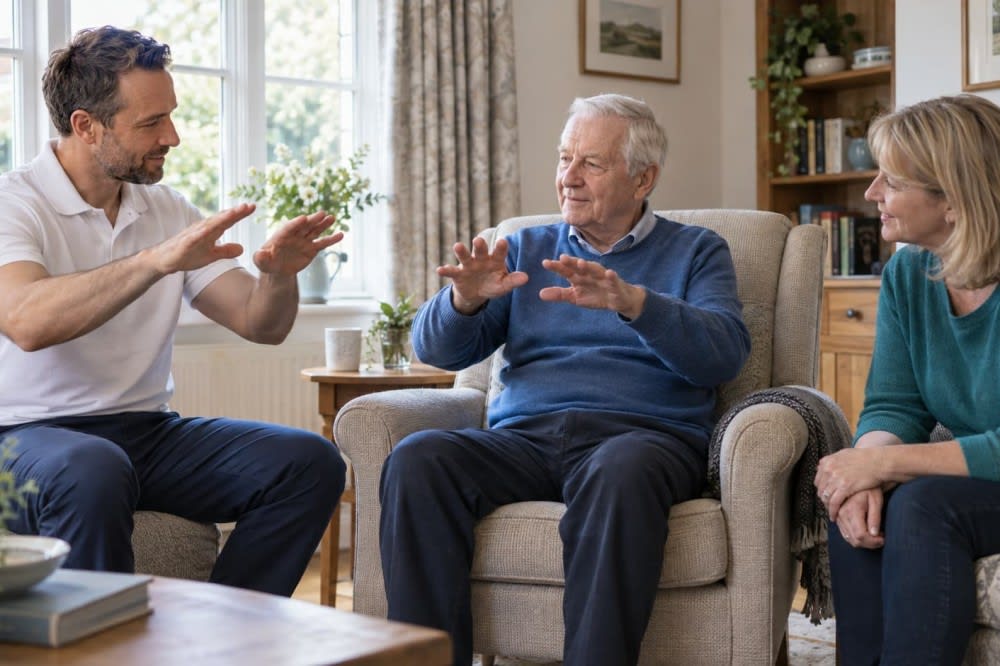
An explanation that makes sense to one person may be confusing to another. We might demonstrate a movement, use one short instruction at a time or allow longer for a response. Appropriate hands-on guidance may be considered following assessment and with attention to consent and comfort.
A familiar relative or carer may help the person feel secure. Sometimes, however, someone responds better to a professional than to a family member. We explore this together rather than assuming relatives must take on the coaching role.
The aim is to find a way of communicating that makes the activity understandable and reassuring for this individual.
A qualitative study of people living with dementia and their carers described difficulties with complicated exercises and the need for individually adapted support. Read the patient and carer study .
Exercise Can Be Part of an Everyday Task
Formal exercises can feel abstract, especially when the movement is unfamiliar. In my practice, I often use the activity the person needs to achieve as the starting point for treatment.
Depending on their assessment and goals, this might involve:
- Practising turning in bed to help with everyday care
- Working on supported sitting balance
- Practising standing from a chair
- Walking to a familiar place within the home or outdoors
For someone who can engage with a structured strength or balance programme, demonstration and patient repetition may help. The therapist assesses the assistance, equipment and number of people needed, alongside how much activity the person can manage.
Meaningful participation can extend beyond walking. Supported time outside or joining others in another room may be valuable goals, including when a wheelchair is needed.
These are examples of individually assessed treatment, not an exercise programme for families to attempt without appropriate guidance.
Case Example: Keeping a Familiar Outing Possible
I supported an older gentleman who had become largely confined to bed after a prolonged hospital admission. Rehabilitation initially helped him regain movement, use a walking aid and access more of his home.
As his dementia and support needs became clearer, the approach changed. Physiotherapy, occupational therapy and rehabilitation assistant input were coordinated with his family. Assistants used clear communication, visual demonstration and a patient approach to support his strength and balance programme between physiotherapy reviews.
One goal was particularly meaningful to him: walking to a local shop for a favourite treat. That familiar purpose connected rehabilitation with something he wanted to continue doing.
His dementia continued to progress and his care needs increased. Support evolved to include carers with rehabilitation skills, helping him participate in washing, dressing and other daily activities. Speech and language therapy was also involved. His family remained closely engaged throughout.
The team supported him to continue valued activities for as long as was feasible. Over time, our goals moved from recovering abilities towards supporting participation as his needs increased.
Rehabilitation can have a meaningful purpose even when the underlying condition continues to progress.
Personal details have been generalised to protect privacy. This example illustrates clinical reasoning; it cannot establish what would have happened without therapy or predict another person’s outcome.
Making Activity Part of the Routine Between Visits
We aim to agree a small, achievable plan that fits into everyday care. This might mean one or two activities at a familiar time, with the right person available to help. It does not mean exercising throughout the day or turning every interaction into therapy.
A Familiar Routine
Link a short, agreed activity to a suitable part of the day, such as after morning care if that is a good time.
The Right Support
Establish whether a relative, carer or rehabilitation assistant is best placed to provide patient encouragement.
A Manageable Plan
Choose activities and assistance that have been assessed, demonstrated and agreed with the therapist.
A rehabilitation assistant can help practise a programme prescribed and reviewed by the physiotherapist. The plan must also be realistic for carers: relatives should feel supported, rather than responsible for delivering a demanding programme alone.
Alzheimer’s Society offers further advice on adapting activity to preferences and supporting difficulties remembering exercises: getting started with exercise when living with dementia .
Positioning and Sitting Balance Also Deserve Attention
In my clinical work, I sometimes see people who spend long periods reclining and who also struggle with sitting balance or become frightened when moving forwards. This needs individual assessment; reclining alone should not be assumed to have caused the difficulty.
We can advise on suitable seating, supported changes of position and opportunities for upright activity, balanced with comfort, fatigue and other health needs. Rest remains important, and the plan needs to suit the individual.
If someone leans heavily backwards, panics when moving or needs help to stand, ask for an assessment. Families should not try to correct the lean or introduce standing equipment without guidance and training.
What If the Person Becomes Frightened or Wants to Stop?
Pause, offer reassurance and consider what is making the activity difficult. We may simplify the task, change the surroundings or return at a better time. We avoid pressure, criticism and warnings that the person will deteriorate unless they exercise.
For a wider discussion of reluctance and family pressure, see My Elderly Parent Refuses Physiotherapy or Won’t Exercise—What Can I Do?
Dementia Does Not Automatically Remove the Right to Decide
Adults should be presumed to have capacity unless there is evidence otherwise. Capacity relates to the particular decision at the time, and the person should receive support to make it. Difficulty following an exercise is not, on its own, a capacity assessment.
If the person has capacity to decide about treatment, their decision must be respected. If they lack capacity for that decision, the clinician must follow the appropriate best-interests process, considering their wishes and involving relevant people. A relative’s request alone does not authorise treatment, and distress should prompt reassessment of the approach.
Read the NHS guidance on the Mental Capacity Act in England and Wales and consent to treatment .
How Do We Decide Whether Physiotherapy Is Helping?
We agree goals and review points from the outset. Depending on the individual, goals might include needing less help to stand, maintaining a short supported walk or participating more comfortably in daily care.
Some people regain abilities, particularly after an illness or hospital stay. For others, maintaining an activity or adapting support is the more realistic aim. Dementia can continue to progress despite appropriate rehabilitation.
At review, we discuss what has changed, what remains difficult and whether the treatment burden and cost are justified. If goals are not being met, we explore whether pain, illness, communication, timing or the programme itself needs attention.
Sometimes ongoing rehabilitation remains worthwhile. Sometimes less frequent advice, better care support, comfort or access to enjoyable activities is a better use of the person’s energy and finances. Continuing appointments should have a clear purpose.
Maintaining a valued ability can be a worthwhile goal. Reviews should consider whether treatment is contributing to that aim, rather than assuming either that no improvement means failure or that stability proves benefit.
When a Change Needs Medical Attention
Sudden new confusion needs emergency medical assessment.
If someone suddenly becomes confused, or abruptly much more confused than usual, seek emergency help. NHS guidance advises going to A&E or calling 999. Do not assume this is simply dementia progressing or try to manage it by increasing exercises.
Gradual unexplained changes in movement, balance or everyday abilities should also be discussed with the person’s healthcare team. Physiotherapy assessment can form part of that wider review.
NHS guidance on sudden confusion .
Frequently Asked Questions
Does someone need to remember exercises between appointments?
Not necessarily. An agreed programme may rely on reminders, demonstration and support from another person. The therapist should establish whether that support is available and realistic, rather than expecting independent practice that the person cannot manage.
Can physiotherapy still be considered in advanced dementia?
It may still have a role, but goals and expectations need careful assessment. Advice on positioning, movement during care and appropriate assistance may be more relevant than a demanding exercise programme. Comfort, wishes, distress and the burden of treatment must guide decisions.
How often should someone with dementia have physiotherapy?
There is no single schedule suitable for everyone. Frequency depends on the goals, response to treatment, health, fatigue and support between visits. Some people need closer supervision; others may benefit from a programme supported by carers or rehabilitation assistants with periodic physiotherapy reviews.
What does home physiotherapy cost?
Fees depend on location, travel and the support required. Ask for the proposed costs and review arrangements before starting. Our guide explains home physiotherapy costs and what a specialist visit includes .
Discuss Home Physiotherapy for Someone With Dementia
If your relative struggles to follow exercises, an assessment can explore their abilities, the support around them and whether adapted physiotherapy has a useful role. Visiting at home allows the therapist to see the tasks, surroundings and routines that matter to them.
Learn more about our dementia physiotherapy and home physiotherapy services .
The aim is to find movement that feels understandable, achievable and meaningful—and to keep reviewing whether it helps.
Estuary Physio provides home visits across Essex and selected areas of London and Surrey . Our team can confirm whether a physiotherapist with appropriate experience covers your relative’s postcode.
Speak to Our Team About Dementia Physiotherapy
Tell us what has changed, what your relative finds difficult and what matters to them. We can discuss whether an assessment would be appropriate and how family members or carers could be involved.
Discuss Your Relative’s Needs