


posted 4th November 2025
Why Balance and Coordination Training Matters
Parkinson’s disease affects the brain’s ability to control movement, which can lead to challenges with balance, posture, and coordination. This often causes people to feel unsteady or have difficulty with everyday activities like walking or standing. The good news is that with targeted balance and coordination exercises, you can improve your stability and movement control, helping you feel more confident and steady on your feet.
Getting Started Safely at Home
Before beginning any exercise routine, it’s important to create a safe environment:
Core Balance Exercises for Parkinson’s
Heel-to-Toe Walking
Start position: Stand tall with your feet hip width apart near a sturdy surface for support.
Movement steps:
Posture cues: Keep your head up, shoulders relaxed, and engage your core muscles to maintain good posture.
Safety tips: Use a wall or countertop for balance if needed. Stop if you feel unstable.
Sit-to-Stand with Control
Start position: Sit on a sturdy chair with feet flat on the floor, hip width apart.
Movement steps:
- Lean slightly forward, engaging your core.
- Push through your feet to stand up slowly without using your hands.
- Pause briefly at the top, then slowly sit back down with control.
Posture cues: Keep your back straight and shoulders relaxed throughout.
Safety tips: Use armrests or a helper if needed. Perform near a wall for extra support.
Weight Shifting and Reaching
Start position: Stand with feet hip width apart, near a support surface.
Movement steps:
- Shift your body weight onto your right foot.
- Reach forward or to the side with your opposite arm while maintaining balance.
- Return to the starting position.
- Repeat on the other side.
Posture cues: Keep your hips level and engage your core.
Safety tips: Hold onto a support surface if needed. Move slowly and deliberately.
Supported Single-Leg Balance
Start position: Stand next to a sturdy surface, feet hip width apart.
Movement steps:
- Hold onto the support with one hand.
- Lift your left leg off the ground, bending the knee slightly.
- Hold the position for 10 to 20 seconds.
- Lower your foot and repeat with the right leg.
Posture cues: Stand tall with shoulders relaxed and core engaged.
Safety tips: Use support as needed and avoid locking your standing knee.

Coordination Exercises to ‘Train the Brain’
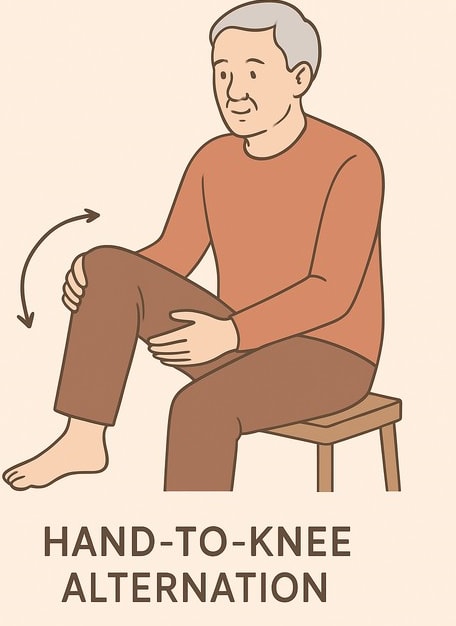
Hand-to-Knee Alternation
Start position: Sit or stand comfortably.
Movement steps:
- Lift your right hand and touch your left knee.
- Return to start.
- Lift your left hand and touch your right knee.
- Repeat slowly, increasing speed as comfortable.
Progression: Move from sitting to standing, or increase speed.
March and Tap (Dual-Task Training)
Start position: Stand with feet hip width apart.
Movement steps:
- March on the spot, lifting knees high.
- Tap your opposite hand to your raised knee.
- Continue alternating sides.
Progression: Add counting or naming items aloud while marching.
Throw-and-Catch with a Partner or Wall
Start position: Stand or sit with a light ball or bean bag.
Movement steps:
- Throw the ball gently to a partner or against a wall.
- Catch it with both hands.
- Repeat, varying speed and distance.
Progression: Increase speed or try catching with one hand.
Dual-Task Balance Challenge
Start position: Stand near support if needed.
Movement steps:
- Balance on one foot.
- While balancing, count backward from 20 or name items in a category (e.g., fruits).
- Switch legs and repeat.
Progression: Reduce support or increase task difficulty.
Integrating These Exercises into Daily Life
Incorporate small “movement snacks” throughout your day to build balance and coordination:
- Practice heel-to-toe steps during TV adverts.
- Perform sit-to-stand exercises while waiting for the kettle.
- Use music or rhythm to cue your movements, making exercises more enjoyable.
- Aim for consistency by doing a few minutes daily rather than long sessions sporadically.
When to Seek Professional Support
If you find exercises too easy or too hard, feel unsafe, or experience increased symptoms, it’s time to consult a neurological physiotherapist. They can tailor your exercise plan to your needs and help you progress safely.
Tio find out more about the service and support we provide, visit our service pages at:
OR if you would like some ideas for other exercises which you can do at home visit our Neuro Move Academy

Frequently Asked Questions
How often should I practise balance exercises?
Aim for at least 3 to 5 times per week, starting with short sessions and gradually increasing duration as you feel comfortable.
What if I feel dizzy or unsteady?
Stop the exercise and rest. If dizziness persists, consult your healthcare provider before continuing.
Can I still improve coordination in later stages?
Yes. While progress may be slower, ongoing practice can help maintain and improve coordination at any stage.
Do I need equipment for Parkinson’s exercises at home?
Most exercises require no special equipment. A sturdy chair, a wall, or a light ball can be helpful but are not always necessary.
By following these evidence-based balance and coordination exercises, you can safely improve your stability, posture, and confidence at home. Remember, consistency and safety are key, and professional guidance can help you get the most from your practice. You’re not alone on this journey — Estuary Physio is here to support you every step of the way.
Reviewed by Barry Ford BSc, Chartered Physiotherapist.
For more information visit our Parkinson’s Condition Information Page and Parkinson’s Physiotherapy Service, or explore our Neurological Physiotherapy and Home Physio options for tailored ongoing support.